

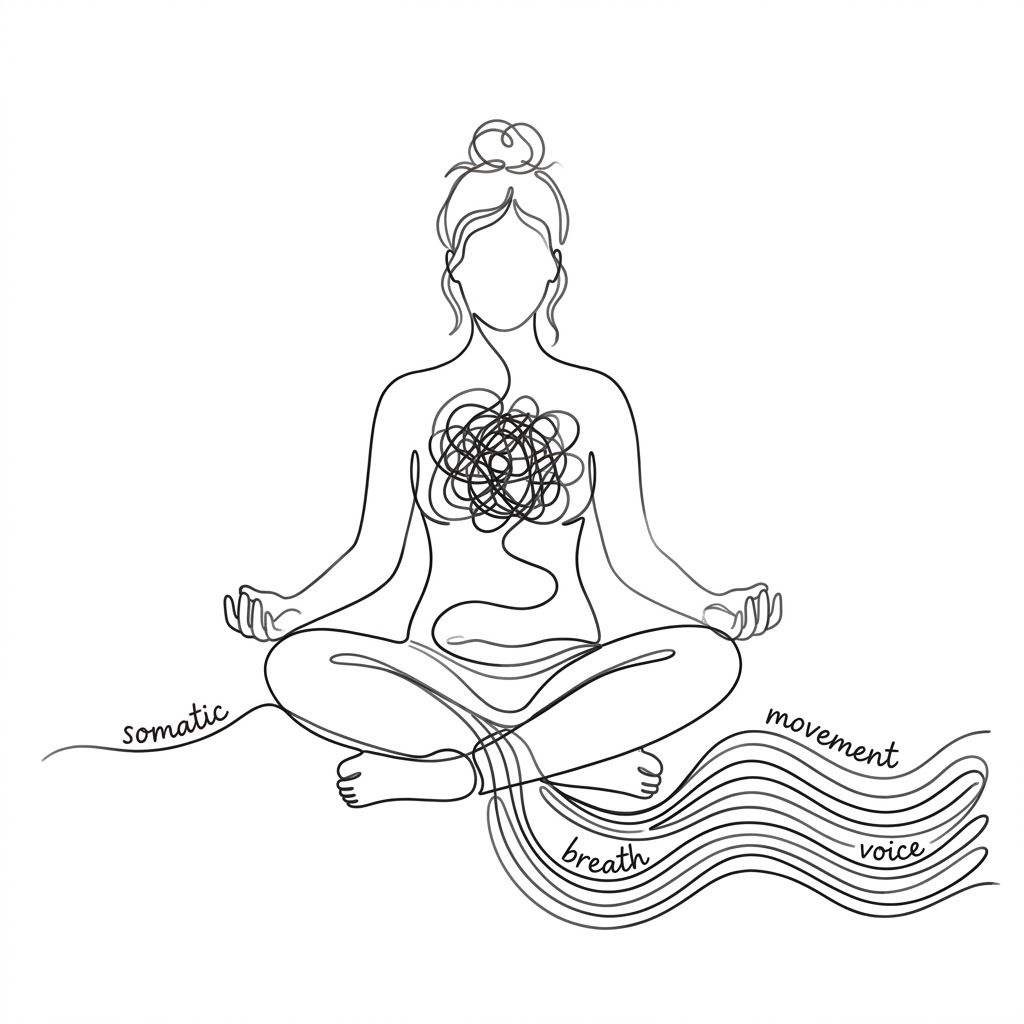
Aphantasia, chronic pain, and nervous-system work
Somatic tracking is the practice of noticing body sensations with curiosity and a sense of safety, so your nervous system can learn that a sensation doesn’t have to mean danger. If you can’t visualize, you can still do it. Instead of picturing calm in your head, you anchor your attention in your body and the real world around you, using sight, sound, touch, movement, breath, and words.
If you’ve ever been told to “picture a safe place” and felt nothing (or felt worse), this article is for you. We’re mind-body coaches who have lived through chronic pain, fatigue, burnout, and anxiety ourselves. One of our co-founders, JP Stones, has aphantasia and spent years with chronic joint pain, so he knows firsthand how badly regulation tools can fit when they assume you have a mind’s eye.
Can you do somatic tracking without visualization?
Yes. Somatic tracking without visualization means paying attention to what you actually feel in your body, anchored in the present moment and the room around you, not in imagined images. The goal is the same as standard somatic tracking: help your nervous system feel safe with sensation.
Your nervous system works a bit like a smoke detector. When it senses danger, whether physical, environmental, or emotional, it can trigger protective responses like pain, fatigue, and tension. Those responses are meant to be short-term. When the danger signal doesn’t switch off, they can become chronic.
Somatic tracking is a core practice in Pain Reprocessing Therapy (PRT), and it’s one of the main ways we help that alarm settle. Many guided versions lean on imagery (“picture the sensation as a color,” “imagine it softening”). For someone with aphantasia, we skip the imagery. We keep the core idea, which is noticing sensation with curiosity instead of fear, and we build it on things you can actually perceive. This is what we mean by non-visual regulation: somatic and regulation tools that use the body, the room, movement, breath, sound, touch, and words, with no mental pictures required. You can read more about how we work with aphantasia.
Why do standard visualization meditations make chronic pain worse for some people?
For people with aphantasia or weak mental imagery, visualization-based calming can give no felt sense of safety, add performance pressure, and turn attention inward in a way that makes pain and anxiety louder. You aren’t putting in the wrong effort. You’ve been given the wrong tool.
Most calming tools, from meditation apps to pain clinic programs, assume you can easily bring up a world behind your eyelids. When you can’t, a few things tend to happen:
- No felt safety signal. The instructions never really land in the body.
- Performance pressure. “Why can’t I see anything?” becomes one more source of stress.
- More body noise. Closing your eyes and focusing inward can amplify pain and anxiety instead of settling them.
We call this the visualization trap: treating imagery as the default way in, when your system may need external and embodied entry points first. When we see this happen, we adapt the work. We don’t blame the person.
How does aphantasia change nervous-system work?
Aphantasia doesn’t stop you from regulating your nervous system. It changes where the work starts. Instead of building safety as a picture in your head, you build it through your body and your surroundings.
Aphantasia means you don’t voluntarily “see” images in your mind. It’s estimated to affect about 1 in 20 people. You can still imagine, plan, remember, and create, often through language, logic, movement, and the outside world rather than an internal movie screen. Many people have weak imagery rather than none at all, so it’s a spectrum.
We think of aphantasia as a different operating system, not a disability. JP worked as a professional photographer for a decade, and he credits that to the way his brain works. That kind of compensation can become a real strength when regulation happens in the world and the body. In practice, non-visual regulation tends to rest on three things:
- External anchors: sight, sound, touch, space, and environment.
- Movement, breath, and voice: bottom-up somatic work, including posture and small movements, especially when going inward makes symptoms louder.
- Evidence-informed depth: PRT- and Emotional Awareness and Expression Therapy (EAET)-informed work, plus Hakomi-informed and parts-informed work when emotions and protective patterns are involved.
How can you track sensation without a mental image?
You track sensation through direct perception and words instead of pictures. Keep your eyes open and your attention anchored in the room, then briefly notice and describe a sensation before returning to something that feels neutral or safe. Movement and breath can do the job that imagery does in standard scripts.
Here’s the general shape of how we approach it in coaching. Treat it as an outline to explore with support, not a medical treatment:
- Start outside the body. Keep your eyes open. Notice something you can see, hear, or touch, like the texture of a chair or a sound in the room. This gives your system a real-world anchor.
- Visit the sensation briefly. Turn your attention to the sensation for a short moment. You don’t need to picture it. Just notice it.
- Use words, not images. Describe it plainly: warm, tight, buzzing, dull, moving, steady. Language is a natural strength for many people with aphantasia.
- Return to the anchor. Come back to the room, the chair, or the sound. Moving between the sensation and a safe anchor is part of the practice.
- Let the body take part. If stillness makes symptoms louder, use gentle movement, breath, or voice instead of forcing yourself to sit with your eyes closed.
Underneath all of this is the same message PRT aims for: this sensation is something my system can be with safely.
Do visualization and meditation still have a place if you have aphantasia?
Yes, they can. They just may not be the right place to start. Where you sit on the imagery spectrum, and how your nervous system responds, shapes which tools come first.
Visualization, meditation, and practices drawn from ACT and MBSR can still be useful. For some people they fit right away. For others they work better once the nervous system has more capacity, after regulation has been built through the body and the world first. Our approach is to understand your system first and then adapt the tool to fit it. We don’t ask you to fit a generic program. For a deeper dive, read Meditating with aphantasia and the hub on non-visual regulation.
Working with us
If you can’t visualize and you’ve felt like nervous-system work wasn’t made for you, you’re not broken. You may simply need a different operating manual. At Chronic Conditions Clinic, JP Stones, who has aphantasia, offers one-on-one coaching online or in person, shaped by his own lived experience of chronic symptoms.
See how we approach aphantasia coaching and book a free, no-pressure consultation.
This article describes our coaching approach and is not medical advice, diagnosis, or treatment. Please work with your healthcare provider on any medical concerns.